What if the most beautiful wedding film isn’t the one that feels most like your wedding? When deciding what to look for in a wedding film, a polished portfolio can be hard to compare: a striking highlight may not show how real conversations, meaningful pauses, or the ceremony are captured. Look beyond the most cinematic shots. Notice whether the film helps you feel the day again, not simply admire how it looks.
It’s natural to want graceful images and a moving story while wondering whether cameras will make you pose or perform. A documentary-inspired approach can preserve unscripted affection, happy chaos, and quiet moments without pulling you out of them. The aim is not to make every second look perfect, but to shape real moments into a story you’ll want to revisit.
This checklist will help you assess emotional honesty and storytelling, then see how picture, sound, pacing, and coverage work together. You’ll learn what a short highlight can and cannot show, how to assess vows and speeches, and how to describe the film that feels personal to you. By the end, you can compare samples with greater confidence and a clearer sense of how you want to remember your celebration.
Key Takeaways
- Learn what to look for in a wedding film by noticing unforced reactions and atmosphere, not just polished visuals.
- See how vows, speeches, ambient sound, and music each add a different layer of feeling to the story.
- Compare film samples for tone, pacing, ceremony context, sound, and emotional range to find a style that feels right for you.
- Use a simple viewing process to identify the people, traditions, and moments you most want your film to preserve.
- Discover how Shutterink’s documentary-inspired storytelling pairs candid moments with elegant, emotional visuals.
What to look for in a natural wedding film
You want to remember your wedding as it felt, not as a production you had to direct. A natural wedding film doesn’t mean the camera is absent or every image happens by chance. It makes room for real reactions, familiar gestures, and the atmosphere around them, while thoughtful framing and editing give those moments shape.
That balance matters in modern Indian celebrations, where a day might move between intimate rituals, heartfelt conversations, and a dance floor full of happy chaos. The Wedding Videography Overview offers a broad introduction to the medium. When watching samples, focus on whether the filmmaking feels attentive to people and events, rather than arranged primarily for the lens.
Does a wedding film mean you have to act?
No. Being present is different from performing. You can greet your family, take part in your ceremony, and enjoy the celebration without repeatedly pausing to recreate a moment for the camera. In relaxed, unobtrusive coverage, the filmmaker observes interactions as they unfold and may offer brief direction when a considered shot serves the story. You may notice the camera at times, but you shouldn’t feel responsible for making the day look emotional or entertaining. A meaningful film can hold tears, movement, laughter, and the delicious disorder of a busy celebration without asking you to act out your own memories.
How to spot genuine moments in a film
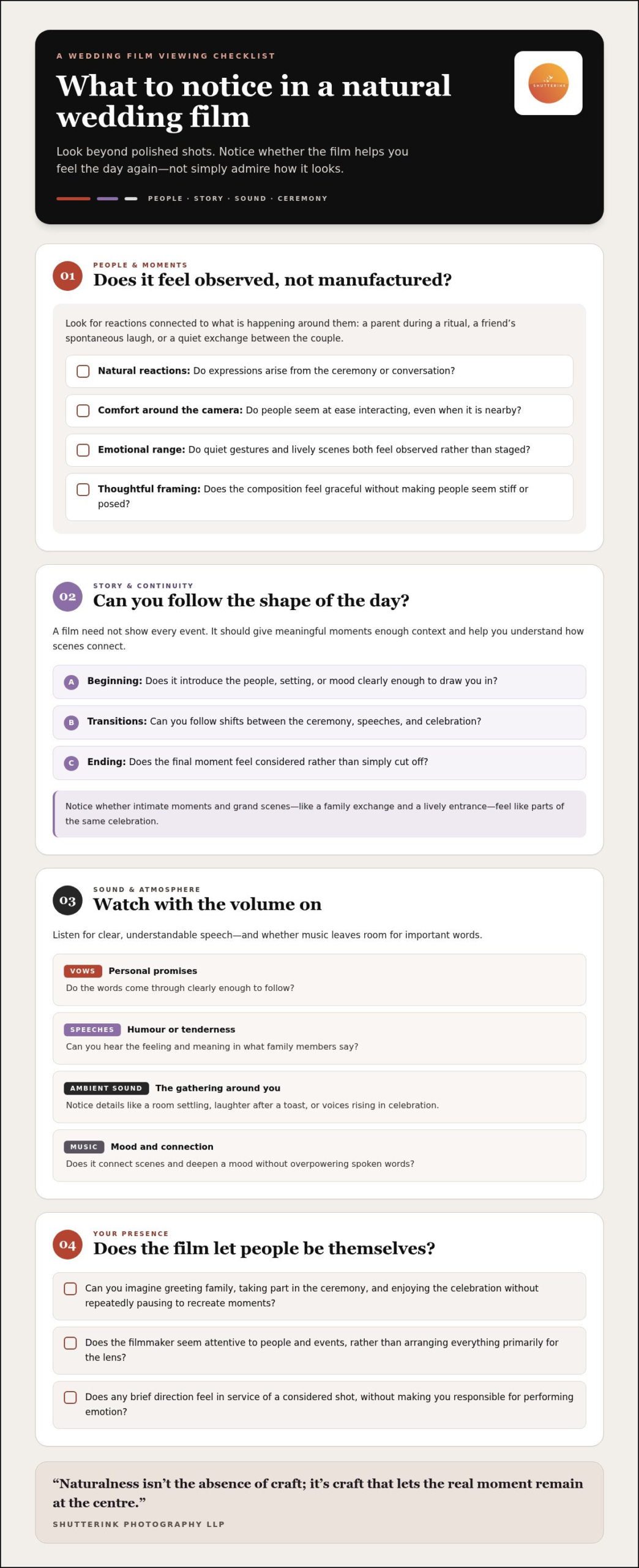
Look for moments that feel connected to what’s happening around them. A parent’s expression during a ritual, a friend’s spontaneous laugh, or a quiet exchange between the couple should feel like part of the celebration, not a scene inserted only to prompt a reaction. Watch both soft, reflective passages and energetic scenes. Do people seem engaged with each other, or focused on following directions?
As you view a sample, notice whether:
- Reactions arise naturally from the ceremony or conversation.
- People look comfortable interacting, even when the camera is nearby.
- Quiet gestures and lively scenes both feel observed, not manufactured.
- Composition feels thoughtful without making people seem stiff or posed.
Naturalness isn’t the absence of craft; it’s craft that lets the real moment remain at the centre. That’s a useful principle when deciding what to look for in a wedding film: graceful framing can sit alongside an unplanned embrace, a trembling voice, or everyone laughing at once.
Notice your own response, too. Do you sense the closeness between people and the energy of the gathering, even if you don’t know the couple? A documentary-inspired approach can preserve unscripted exchanges while shaping them into an elegant, emotionally resonant story. The result can feel polished without becoming stiff, personal without being overly staged, and true to a celebration in all its tenderness and joyful commotion.
Assess the story, sound, and ceremony coverage in a wedding film
A striking image can catch your eye, but a wedding film’s story, sound, and coverage shape how much of the day you can understand and feel. As you decide what to look for in a wedding film, watch beyond its most dramatic moments. Notice how it gives those moments context, carries you between parts of the celebration, and lets important voices come through.
What makes the story feel complete?
A film can feel coherent without showing every event from beginning to end. Look for enough context to understand why a moment matters: a glimpse of the ceremony before a meaningful reaction, for example, or a speech that leads naturally into a scene of family and friends celebrating. Transitions should help you follow the day rather than leave you wondering how one scene connects to the next.
Consider whether intimate and grand moments feel like parts of the same celebration. A quiet exchange between family members might sit alongside a lively entrance or a packed dance floor. The edit doesn’t need to document everything, but its choices should give the day a recognisable shape and emotional continuity.
While watching a sample, try this simple check:
- Beginning: Does it introduce the people, setting, or mood clearly enough to draw you in?
- Transitions: Can you follow shifts between ceremony, speeches, and celebration?
- Ending: Does the final moment feel considered, rather than simply cut off?
These are prompts, not strict rules. A quieter ending may suit a tender film, while an exuberant celebration might call for a more spirited finish.
Why sound matters as much as beautiful images
Watch with the volume on. Listen for whether vows, speeches, or meaningful words spoken during your ceremony are clear enough to follow. Then notice the sounds around them: a room settling, laughter after a toast, or music and voices rising during a celebration. These details can bring texture to a scene without needing explanation.
Each kind of sound carries a different feeling. Vows can reveal personal promises; speeches may hold a family member’s humour or tenderness; ambient sound can place you inside the gathering. Music can connect scenes and deepen a mood, but it shouldn’t overpower important spoken words. Listen for balance, not perfection. When comparing samples, note whether speech is understandable and whether music leaves room for it.
Clear recorded voices give images their context, helping you remember not only what a moment looked like, but what was said and why it mattered.
Relate what you hear and see to your own celebration. Depending on your ceremony and family traditions, meaningful details might include spoken rituals, blessings, a loved one’s reaction, or a particular part of the vows. A thoughtful film makes room for the moments that matter to you, without treating every wedding as though it follows the same script. Shutterink’s commissioned wedding films bring documentary-inspired storytelling together with elegant, emotional visuals. Explore Shutterink’s wedding films to see how that approach can hold both intimate exchanges and celebratory energy.
Compare wedding film samples for style, pacing, and consistency
A striking teaser can show beautiful images, but it may not reveal how a film sustains its feeling beyond a few memorable seconds. When possible, watch several complete examples. You’ll get a clearer sense of how each film develops, how the filmmaker moves between different parts of a celebration, and whether the visual style feels consistent from beginning to end.
As you compare, separate personal taste from storytelling craft. A quiet, reflective film isn’t automatically more thoughtful than a lively, energetic one. The better fit is the style that feels closest to how you want to remember your celebration. Visual polish matters, but it serves the story best when it deepens the atmosphere instead of becoming the whole point.
How pacing and tone shape the viewing experience
Notice how long the edit stays with a moment. Does it allow a meaningful pause to register, or move away just as an exchange begins to feel important? A fast rhythm can suit exuberant scenes, while slower passages may give tenderness room to breathe. Pay attention to how the two styles sit together. Ask whether the overall mood feels aligned with your memories, or with the atmosphere you hope your day will hold.
What to compare beyond a short highlight
A longer example can reveal what a teaser can’t: whether the film keeps your attention after its opening montage, whether transitions feel clear, and whether speech remains understandable across different scenes. Look for consistency in colour, framing, and sound, while allowing for natural changes between settings and lighting. Also note the format you’re viewing. A short highlight may have a different purpose from a longer film or a ceremony-focused edit.
To make comparisons easier, use a simple scorecard. For each sample, jot down a few words rather than trying to rank every detail:
- Tone: Does it feel intimate, exuberant, cinematic, or some blend?
- Pacing: Are emotional pauses given room, and do lively scenes retain their energy?
- Sound: Can you follow spoken words, and does music support the mood?
- Ceremony context: Can you understand the important moments shown?
- Emotional range: Does the film hold both quieter exchanges and celebration?
Compare like with like where you can. A short teaser and a longer film may be edited for different reasons, so don’t treat them as identical evidence of style. Instead, record what each sample helps you assess and what you can’t judge from that format. This keeps your impressions grounded in what you’ve actually watched.
Then compare notes with your partner. You may respond to different details: one of you might value clear ceremony context, while the other is drawn to the pace and visual mood. Those preferences don’t need to match exactly. Together, they can help you describe what matters most and recognise a film whose craft supports your story, rather than asking you to fit someone else’s idea of a perfect wedding.
Wedding film checklist: define what matters to you
Before comparing more films, decide what you hope yours will hold. Your celebration may include several ceremonies, overlapping family moments, familiar voices, and a shift from quiet reflection to joyful commotion. There’s no single checklist that suits every couple. The aim is to identify which memories feel essential to you and which creative touches are simply a matter of taste.
A practical wedding-film review checklist helps turn a general feeling, such as “we want it to feel personal,” into details you can share. Keep your notes specific but flexible. A film can honour the moments you care about while leaving room for genuine surprises.
A simple process for reviewing wedding films
Use the same steps for each sample so your impressions are easier to compare. First, let the film play without pausing. Then watch again with particular details in mind. Finally, talk through your notes together, looking for shared priorities rather than trying to agree on every preference.
- Watch for the feeling. Note the mood that stays with you afterward: tender, lively, intimate, or a mix. Write down one moment that made the film feel affecting or recognisable.
- Review the details. Pay attention to sound, transitions, ceremony context, and emotional variety. Consider whether the film gives enough attention to the kinds of moments you value.
- Compare your notes. Share what stood out to each of you, then identify the qualities you both want your own film to carry.
Turn your priorities into a clear creative direction
Write down the people, moments, and sounds that carry meaning for you. Depending on your celebration, these might include a ceremony or ritual, a family member’s words, a particular relationship, or the atmosphere of a gathering. Your list doesn’t need to assume that every tradition matters equally, or that both partners feel the same way about every detail.
Separate your notes into two groups: memories you most want preserved and creative preferences you’d enjoy. A loved one’s voice or an important ceremony may sit in the first group; a gentle pace or a more energetic musical mood may belong in the second. This makes your priorities clear without turning them into a rigid shot-by-shot script.
Describe the feeling in everyday language. “Warm and unhurried” or “full of movement, but still intimate” gives a more personal direction than technical terms you may not use naturally. Leave space for unscripted exchanges, unexpected laughter, and the small details you couldn’t have planned.
A useful wedding-film checklist names the memories that matter, the mood you’re drawn to, and the room you want to leave for the unexpected. With those priorities in hand, explore Shutterink’s wedding films for documentary-inspired storytelling that brings personal stories together with elegant, emotional visuals.
How Shutterink approaches personal wedding films
The checklist in this article can help you name what matters: the feeling of your celebration, the moments you hold close, and the balance of intimacy and energy you want to remember. Shutterink creates commissioned wedding films that are handcrafted, personal, immersive, and timeless. Its approach brings documentary-inspired storytelling together with elegant, emotional visuals, allowing real interactions and considered imagery to belong to the same story.
A documentary-inspired eye for real celebrations
A documentary-inspired approach pays attention to how a celebration unfolds rather than asking it to follow a predetermined scene. A gathering can hold many moods: the focus of a ceremony, a quiet exchange between loved ones, a room filling with conversation, and the joyful momentum of a celebration. Observing those shifts can help a film feel connected to the people and atmosphere of the day, while thoughtful visual choices give the story refinement and shape.
Shutterink works with intimate and destination celebrations across India. Each celebration has its own character, relationships, and meaningful details. The intention is to honour that individuality, bringing spontaneous interactions and considered imagery together without assuming that every couple’s story or traditions look alike.
A wedding film shaped around personal meaning
Your priorities offer a thoughtful starting point. If a particular ceremony, family voice, relationship, or change in atmosphere matters deeply to you, those details can help shape the feeling you hope to see reflected in your film. They don’t need to become a rigid list of scenes to stage. A personal film can hold space for what you value while remaining open to the unscripted moments that make a celebration distinctly yours.
That balance is central to a film that feels both polished and emotionally attentive. Visual refinement can bring grace to a scene; documentary-inspired storytelling can keep attention on the connections within it. Together, they can carry a film from tender moments to a lively celebration without losing its sense of intimacy. The result is intended to feel immersive and lasting, not because every detail is arranged, but because the story is shaped with care.
As you explore wedding films, consider whether the images, pacing, and emotional tone feel true to the memories you want to keep. Shutterink’s approach brings personal meaning and the energy of the celebration into a handcrafted film. Explore Shutterink wedding films to see how documentary-inspired storytelling and elegant visuals come together.
Let your priorities shape the film you’ll remember
The right wedding film doesn’t need to match anyone else’s idea of beautiful. It should feel like a place you can return to, carrying the voices, relationships, and atmosphere that mean the most to you. Keep your notes close as you explore; they can help turn “this feels like us” into a clear creative direction.
Knowing what to look for in a wedding film is a starting point, not a set of rules. Leave room for the unexpected, too. The small exchange you didn’t notice or the moment when the whole celebration comes alive may become part of the memory you treasure most.
Shutterink creates commissioned wedding films and photography with a handcrafted, documentary-inspired approach for celebrations across India. Explore Shutterink’s wedding films to see how a personal perspective can take shape on screen. Trust what feels true to you, and let that guide the story you’ll carry forward.
Frequently Asked Questions
Is a wedding film different from a wedding video?
Usually, “wedding film” suggests footage shaped into a viewing experience, while “wedding video” can refer more broadly to recorded moving images. The terms don’t follow a fixed technical rule, though, and filmmakers may use them differently. Look at the actual examples rather than relying on a label. A useful comparison is whether the sample feels carefully shaped for viewing or primarily documents events as they happen.
Do couples have to pose or act for a wedding film?
No, you don’t have to perform throughout the day. Some filmmakers may offer brief direction for a portrait or a transition, while much of the celebration can be documented as it unfolds. If you feel uneasy about being filmed, notice how the people in sample films behave when the camera is present. Their ease, expressions, and attention to each other can help you judge whether the approach feels comfortable.
What should a wedding film include?
There’s no universal list, because each couple’s celebration has its own traditions and important relationships. Start with what you’d regret not being able to revisit: perhaps a meaningful ritual, a grandparent’s presence, or a sibling’s words. Then consider how much context you’d like around those moments. A film doesn’t need to show every event to feel personal, but its selected scenes should reflect the day’s significance to you.
How long should a wedding film be?
There isn’t one ideal runtime. A shorter edit may suit you if you want a concise way to revisit the day, while a longer film can give more space to ceremonies, speeches, and the flow of events. Think about how you’ll enjoy watching it: in one sitting, with family, or by returning to particular moments. Choose a length that feels complete for your priorities, not one that simply sounds impressive.
Why does audio matter in a wedding film?
Audio brings voices and atmosphere into the memory, including a promise spoken during a ceremony, a toast, or laughter shared among family. Images can show a reaction, but the words that prompted it may add another layer of meaning. As you view examples, listen on headphones or in a quiet room if possible. This makes it easier to notice whether speech is understandable and whether music leaves space for it.
How can we tell whether a wedding film feels authentic?
Authenticity is partly about whether a film’s emotional tone feels familiar to you. Look for expressions and exchanges that seem connected to what’s happening, then ask whether the people come across as themselves. The answer may depend on your own personalities: one couple may love a spirited, fast-moving edit, while another prefers a quieter mood. As you decide what to look for in a wedding film, trust the sample that feels emotionally believable to you.